
 4WARN Insights Blog
Why We Care About Insurance Companies
October 31, 2024 | By Todd Kozikowski, CEO, 4WARN®
Protect the insurance industry?! It may not strike everyone as the noblest cause. We all pay high premiums and insurance companies make big profits. So if you’re wondering about this part of our mission, hear us out.
Everyone needs insurance to cover us in unexpected events like hurricanes, floods, fires, collisions, illness, injuries, errors, omissions, and products manufactured with unforeseen flaws. For both individuals and organizations, insurance is a proven way to pool our risk and protect those who might experience misfortune. That could be any of us.
Fraud undermines this critical safety net and hurts everyone. So does tech-fueled hyperlitigation, in which certain law firms exploit advanced internet marketing techniques to find plaintiffs for lawsuits they sometimes never sought to join. We call this “tech-enabled claims instigation.”
Using AI and other tools, opportunists, including some well-known law firms, scan the landscape for vulnerabilities in insurance policies, statutes, jurisdictions, verdicts, companies, and products. Private equity firms pour millions of dollars into these litigation projects, driving historic increases in claim frequency, costs, and verdicts. The opportunists game search engines in clever ways. Here’s one example: When a legitimate injured party Googles their insurance company’s claims department, they are lured into a fake call center.
Caller: “Is this XYZ Insurance claims department?”
Fraudster: “Well, it’s the claims department.”
This really happened. I was the one dialing the phone, speaking to an “agent” who was impersonating an XYZ employee. And this is just one of many ways that policyholders can become plaintiffs who may never see a dime.
Louisiana’s ordeal
Louisiana has seen the worst of these practices. In 2023, its insurance commissioner fined a law firm $2 million after the firm allegedly misrepresented that it had been retained by home insurance policyholders needing storm-related roof repairs. “MMA’s fraudulent behavior included presenting demands for payment pursuant to the consumer’s insurance policy … and receiving and negotiating insurance settlement checks without the authority to do so from the policyholder,” said the commissioner. Imagine this: Your roof is ripped off in a hurricane, but someone else gets the insurance company’s payout.
The scam allegedly involved at least 850 homeowners. To find claimants, MMA went far beyond the “ambulance-chasing” billboards or late-night TV ads promoting these fraudulent legal practices. The firm reportedly paid an online marketer nearly $14 million for pre-screened client leads – far more than many household-name brands spend on advertising annually.

“The story is not really about MMA. It’s about what is the extent of investment in illegal schemes to sign up clients in all lines of business,” said a New Orleans defense lawyer. “I think this is the future of how cases are being harvested. The days of an attorney waiting for his phone to ring because of a radio advertisement or billboard are already over.”
Driving good people out of business
Dubious lawsuits are creating havoc. Another example: Opportunists are also pursuing logistics companies – the businesses that deliver your next-day mail and packages – and using hyperlitigation to profit from fender benders. In fact, false litigation has become so prevalent in the logistics industry that delivery companies are now adjusting their driving routes to avoid “hot zones” where these opportunists prey.
Hyperlitigation also drives honest companies out of business, reducing competition that keeps rates fair. One of many examples is St. John’s Insurance in Florida. In 2016, the company had 180 new cases of litigation, about one every other day. New cases more than tripled in the next year. Case count soared every year until there were 3,508 new litigations in 2021 – about 20 times more than in 2017. Close to 10 cases a day.
St. John’s and five other Florida insurers with similar experiences went under in 2021. They were litigated to death.
How we started
This collapse, initially identified by Demotech, Inc., during a financial due diligence review of six carrier failures in early 2022, sparked Demotech to ask me to investigate their concern. During that research effort, I discovered that opportunists were using tech-enabled claim instigation as a business model. They leveraged litigation funding and AI-driven litigation platforms to pursue higher settlement amounts and nuclear verdicts in a textbook example of social inflation. However, a lawsuit needs a claimant, and these opportunists had recognized that the best way to target claimants was online by using search engine optimization (SEO).
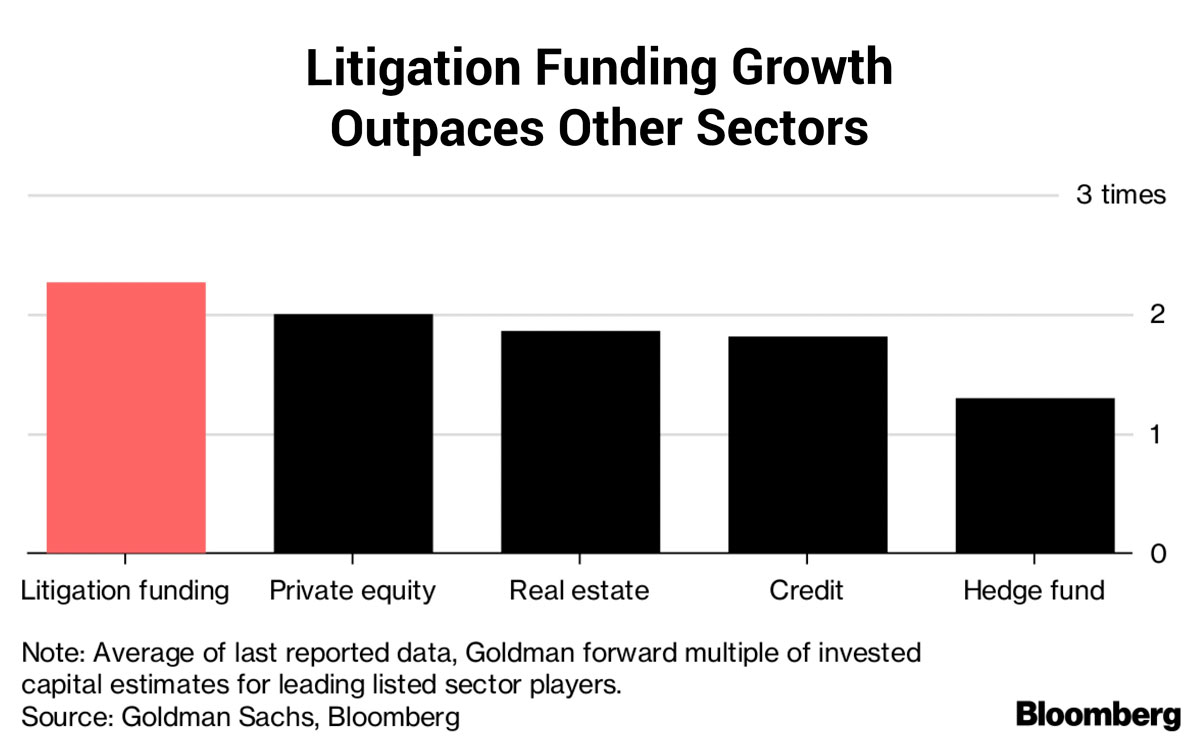
Source: Data and graphic from Goldman Sachs and Bloomberg
Digging into Demotech’s research, I discovered a public adjuster, an individual, spending $50,000 per month on pay-per-click (PPC) advertising. Such players typically anticipate big storms, create instant websites, and outrank in search the claims departments of legitimate insurers. They effectively highjack policyholders, who, as in the Louisiana case, become litigants without knowing it.
Tech-fueled hyper-litigation has become so profitable that it has been drawing investors out of the woodwork. Litigation funding is now an actual investment category. You don’t even have to be a lawyer to own a law firm now. Investors can buy shares in litigation against insurers and other vulnerable companies. Investors committed $2.7 billion to U.S. litigation finance deals in 2023. The category has outperformed private equity, real estate, credit, and hedge funds.
“Insurers have struggled to price for the impact of legal tactic changes, across commercial and personal insurance,” writes Jen Frost in Insurance Business magazine. “Collectively, U.S. casualty insurers put more than $1 billion aside last quarter to make up for ballooning past claims costs.”
Guess who pays? You and I.
Why we won’t stop
At 4WARN, we want to bring sanity and fairness back into the insurance industry. To be clear, we support the practice of law and the fight for deserving plaintiffs. We don’t support tech-fueled claims instigation and hyperlitigators who simply scan the landscape for targets and drain them of their ability to function.
We use data, AI, and machine learning to gather intelligence about tech-fueled hyperlitigation and how it’s occurring. We literally crunch billions of data points to monitor, track, report, educate, advocate and empower organizations to regain control of their brand, online identity, and overall footing.
We use scorecards and heat maps to identify threats, reduce the likelihood of our clients being litigated, minimize the impact of being targeted, alert innocent policyholders, and monitor ongoing threats. We recommend digital countermeasures and intervene with regulators. And we help companies build a digital moat around their business.
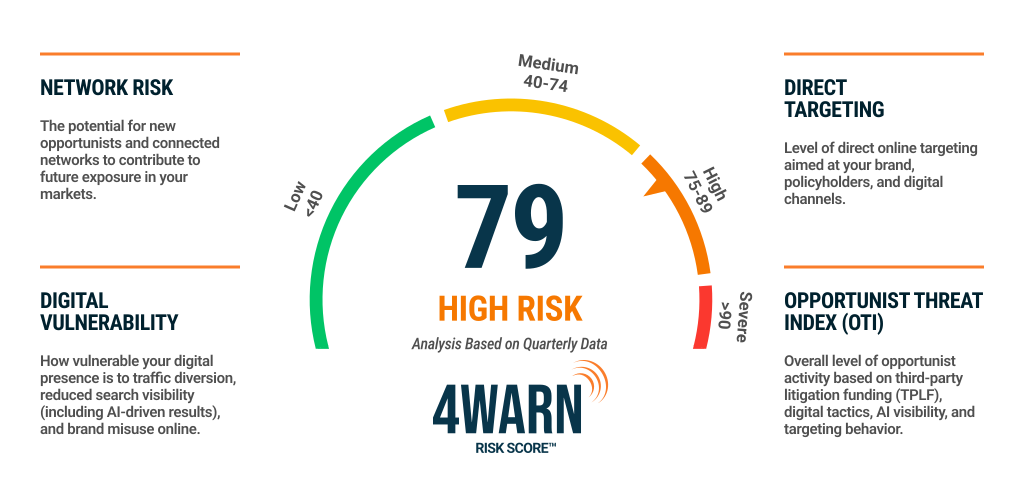
4WARN's Tech-Enabled Risk Score™
No one’s shedding tears for insurance companies and their revenue streams. But the harm they endure trickles down to everyone. Insurance is an inflation driver, and hyperlitigation drives up insurance costs.
We want to protect ourselves and our families. So it’s worth protecting insurance companies. And we’re proud to do it.
About the Author
Todd has over 25 years of experience founding and transforming multiple technology companies, leading organizational growth from start-up to post IPO, and helping build more than $5 billion in market value.
Earlier in his career, Todd co-founded and held leadership roles at Silknet (acquired for $4.2B by Kana), Unica (acquired for $480M by IBM), and Newforma (acquired by Battery Ventures).
Critical to the research that unearthed tech-enabled claim instigation, Todd has developed machine learning algorithms and analytical approaches that predict future events to help measure next-generation cyber risk targeting insurance organizations as well as impacts to financial solvency.
Todd is a graduate of Bates College with degrees in Physics, Astronomy, and Mathematics with advanced studies from the Smithsonian Center for Astrophysics at Harvard University.
Get in Touch with Us Today
Empower your strategy with 4WARN's expertise and steer clear of tech-enabled claim instigation risks.