
 4WARN Insights Blog
Zero-Day Risk Has Moved Outside the Firewall
June 24, 2026 | By Todd Kozikowski, CEO, 4WARN®
Most people have never heard the term "zero-day threat," but they understand the concept.
In cybersecurity, a zero-day threat is a problem that exists before anyone realizes it's there. By the time the organization discovers it, hackers may have already infiltrated a company's systems, installed malware, demanded ransom, stolen data, or caused other damage.
That idea changed how companies think about cybersecurity. Instead of waiting for something bad to happen, organizations use software tools and services to continuously monitor for signs of trouble because they know the earliest warning signs often appear long before a security breach is detected.
A similar challenge is emerging outside the firewall.
When Customers Search for Answers
Today, many claims, lawsuits, complaints, and reputational issues begin long before they appear in an organization's claims file, legal department, or boardroom report. They often start with something much simpler: a person searching for help online.
Imagine a policyholder involved in a car accident. Before contacting their carrier, they open Google and search for answers. Another customer has a claim denied and asks ChatGPT what to do next. Someone dealing with property damage clicks on an advertisement that appears helpful and guarantees financial help. A trucking company employee searches for information after an injury. A patient questions a medical bill and starts researching their options.
In each case, the individual is looking for guidance during a stressful moment.
What many organizations don't realize is that they may never see what happens next after that online search takes place.
Transportation Risk Insights
The person may encounter a law firm, a contractor, a public adjuster, a physician, a referral service, or another third party before they ever speak with the company that already serves them. They may be directed to websites, advertisements, articles, videos, AI-generated answers, or lead-generation services that shape how they think about the situation and what actions they take next.
Weeks or months later, the organization may see more represented claims, increased litigation activity, additional complaints, or rising costs. What they often cannot see is how the online activity that influenced the customer weeks earlier may have contributed to those outcomes.
Part of the challenge is that different departments often see different pieces of the problem. Marketing may notice unusual online activity while claims and legal teams deal with the downstream effects. By the time the issue reaches executive leadership, the connection to the earlier online activity may not be obvious.
Each group sees part of the story, but few organizations have a way to connect those dots.
As a result, many companies continue to treat search results, online advertising, AI-generated content, and website activity as marketing issues when they may also be early indicators of claims, litigation, reputational risk, or fraud.
Why the Zero-Day Comparison Matters
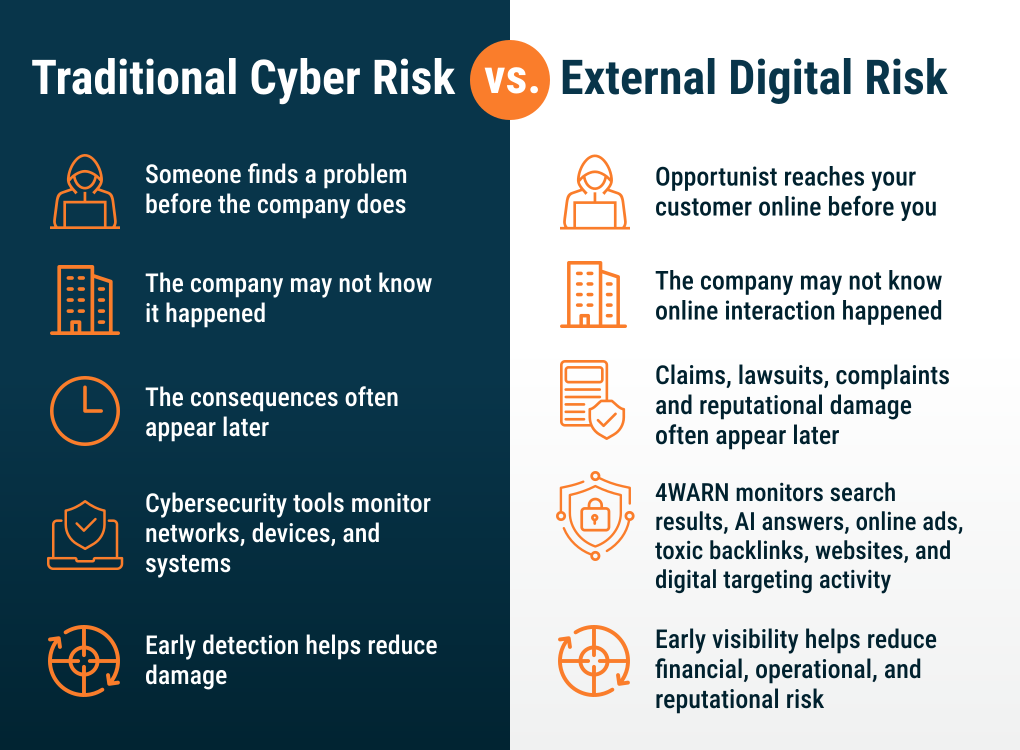
The point is not that online advertising is the same as a cyberattack. The comparison is useful because most organizations already understand why they invest in cybersecurity protection even when no breach has occurred. They know threats can exist long before they become visible. External digital risk increasingly follows the same pattern.
Why This Is Easy to Miss
One reason many organizations struggle with this issue is because the activity itself often appears normal.
Law firms, contractors, public adjusters, healthcare providers, and lead-generation companies advertise online every day. There is nothing unusual, or necessarily illegal, about that.
The challenge is understanding what customers encounter after they click. In some cases, the information is accurate and helpful. In others, customers may be directed to misleading websites, incorrect phone numbers, lookalike domains, inaccurate information, or content that misrepresents an organization, its services, or the options available to the customer.
Those interactions may seem insignificant in isolation. Across thousands of searches, however, they can influence who customers contact, what information they trust, where they share sensitive information, and how they respond to a claim, dispute, injury, or loss.
This challenge is becoming even more complicated every day because AI is rapidly changing how people find information.
Historically, a customer might visit a company website directly. Today, many consumers begin with Google, ChatGPT, Gemini, or another search platform. The answers they receive may come from sources the organization does not control and may never even know exist. In some cases, those answers are accurate and helpful. In others, they may be incomplete, misleading, or influenced by third-party content created to attract traffic, generate leads, or promote specific services.
As more people rely on search engines and AI tools for guidance, organizations have less visibility into who is influencing their customers before a claim is filed, a lawsuit is initiated, or a complaint is made.
Applying a Zero-Day Mindset to Digital Risk
This is where 4WARN differs from traditional enterprise cybersecurity tools.
We operate entirely outside the firewall and monitor the same places customers, claimants, and consumers go when they are searching for answers online. That includes search results, online advertising, AI-generated answers, websites, domains, videos, and other digital activity that may influence how people think, where they click, who they contact, and what actions they take next.
Unlike many enterprise systems, 4WARN does not require access to claims files, internal customer data, or proprietary systems. The goal is not to monitor what is happening inside the organization. The goal is to understand what is happening around the organization before those external activities begin showing up as claims, litigation, complaints, or other operational challenges.
Most organizations would never consider turning off their cybersecurity tools simply because they have not experienced a recent breach. They understand that continuous monitoring is part of responsible risk management.
The same principle increasingly applies to monitoring external digital risk.
Organizations cannot control every search result, advertisement, website, or AI-generated answer. They can, however, understand where those activities are occurring, how they may be influencing customers, and whether emerging patterns are creating additional risk.
The earlier those patterns become visible, the more options organizations have to respond before claims, litigation, reputational damage, and costs become harder, and far more expensive, to manage.
To better understand your organization's external digital risk profile, request a preliminary Digital Risk Threat Assessment from 4WARN.
About the Author
Todd has over 25 years of experience founding and transforming multiple technology companies, leading organizational growth from start-up to post IPO, and helping build more than $5 billion in market value.
Earlier in his career, Todd co-founded and held leadership roles at Silknet (acquired for $4.2B by Kana), Unica (acquired for $480M by IBM), and Newforma (acquired by Battery Ventures).
Critical to the research that unearthed tech-enabled claim instigation, Todd has developed machine learning algorithms and analytical approaches that predict future events to help measure next-generation cyber risk targeting insurance organizations as well as impacts to financial solvency.
Todd is a graduate of Bates College with degrees in Physics, Astronomy, and Mathematics with advanced studies from the Smithsonian Center for Astrophysics at Harvard University.

Get in Touch with Us Today
Empower your strategy with 4WARN's expertise and steer clear of tech-enabled claim instigation risks.