
 4WARN Insights Blog
The New Starting Point for Claims
February 12, 2026 | By Todd Kozikowski, CEO, 4WARN®
Over the past year, we’ve seen some important trends in how claims begin.
Today, many claims don’t start with a call to an insurance company. They start online.
After an accident, storm, or loss, people turn to Google, Bing, or other search engines looking for help and answers. But the information that people find online is not always accurate, and is often intentionally misleading.
The New Digital Front Line of Insurance Claims
Paid ads, AI-generated content, and fake or doppelganger websites are increasingly coming between people and their insurers. Opportunists spend huge amounts of money to outrank carriers and legitimate providers in online search, create lookalike websites, and redirect people into legal marketing networks and third-party litigation funding (TPLF) pipelines, often before a policyholder ever contacts their insurance company about coverage, repairs, or next steps.
We see this every day, and the earliest signs of risk now show up in search results, paid media, and AI responses long before claims data or internal cybersecurity systems show what’s coming.
But what’s truly changed is the expert level of coordination behind it all.
Digital risk is no longer one isolated bad actor or a one-off targeted billboard marketing campaign. It’s now comprised of sophisticated, organized, well-funded, “professional” networks using paid search, AI-generated content, and impersonation websites to intercept people at vulnerable moments and steer them away from insurers and into legal action before trusted conversations can happen.
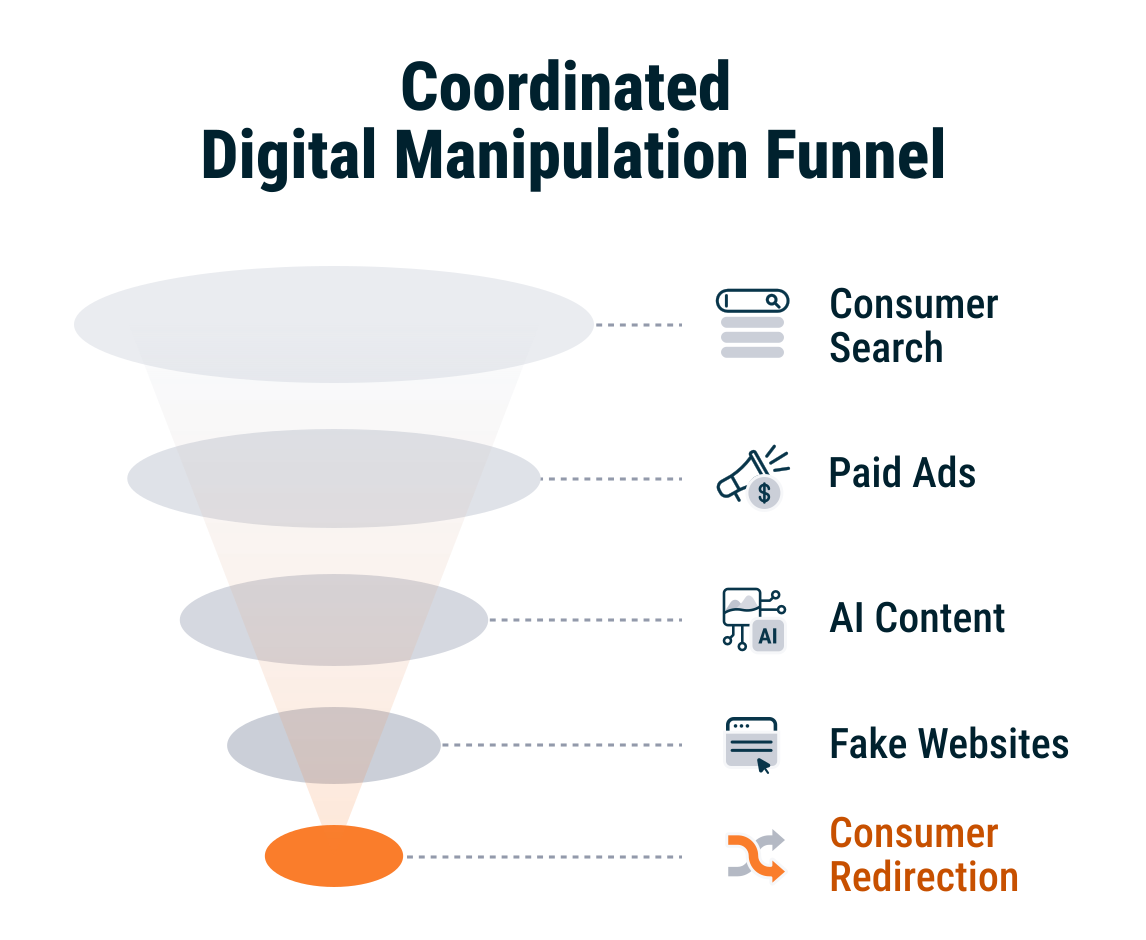
We’ve seen opportunists:
- Launch coordinated pay-per-click (PPC) campaigns that target specific geographies (down to the zip code) and loss types
- Stand up fake or lookalike websites that mimic legitimate organizations
- Use AI-generated content to flood search results with misleading information, sometimes with as many as 700 blogs published in a single day
- Typosquat claims phone numbers and branded URLs (small misspellings that redirect inbound calls and web traffic) to mislead people in moments of crisis
- Route people into funded legal pipelines before insurers ever know there’s a claim or policyholders understand the best way to address their problem
Once someone clicks on these fraudulent links, these websites don’t just provide information. They funnel visitors into intake forms, call centers, and referral networks designed to convert searches into legal cases. Paid clicks become captured leads, and captured leads become litigation, often before insurers ever have a chance to talk to their policyholder.
Traditional cybersecurity and fraud tools weren’t built to detect this kind of activity. Claims systems and SIU workflows operate downstream, after people have already been redirected away from their insurer and into legal marketing funnels.
That’s why early visibility and data intelligence matters.
In this issue of 4WARN Signals, we share some of what we’re seeing across digital targeting, litigation activity, and paid search, as well as insights from our work with the National Insurance Crime Bureau (NICB) and our client intelligence team.
Our goal is simple: to help you see risk earlier, understand how these signals connect, and take action before digital manipulation turns into claims, lawsuits, and brand or reputational damage.
What should you do with this information?
Start by asking a basic question: if someone searches for your company after a loss, what do they actually see? If you don’t know the answer, Google your company name and common claim scenarios. Review the paid results. Check whether any lookalike websites are using your brand name, logo, or phone number.
If you have questions about what you’re seeing, reach out to our team. And if you’d like to better understand how digital manipulation fuels litigation, watch Todd’s NICB interview on Third-Party Litigation Funding.
About the Author
Todd has over 25 years of experience founding and transforming multiple technology companies, leading organizational growth from start-up to post IPO, and helping build more than $5 billion in market value.
Earlier in his career, Todd co-founded and held leadership roles at Silknet (acquired for $4.2B by Kana), Unica (acquired for $480M by IBM), and Newforma (acquired by Battery Ventures).
Critical to the research that unearthed tech-enabled claim instigation, Todd has developed machine learning algorithms and analytical approaches that predict future events to help measure next-generation cyber risk targeting insurance organizations as well as impacts to financial solvency.
Todd is a graduate of Bates College with degrees in Physics, Astronomy, and Mathematics with advanced studies from the Smithsonian Center for Astrophysics at Harvard University.

Get in Touch with Us Today
Empower your strategy with 4WARN's expertise and steer clear of tech-enabled claim instigation risks.