
 4WARN Insights Blog
Digital Risk Trends: What We’re Seeing in the Data
February 13, 2026 | By Beth Owens, Vice President of Analytics
Over the past year, our client intelligence team has been closely tracking how coordinated opportunist networks are changing the way they spend money and reach people online.
We analyzed recent activity from these repeat actors, focusing specifically on their digital advertising and search behaviors.*
Here’s what stood out:
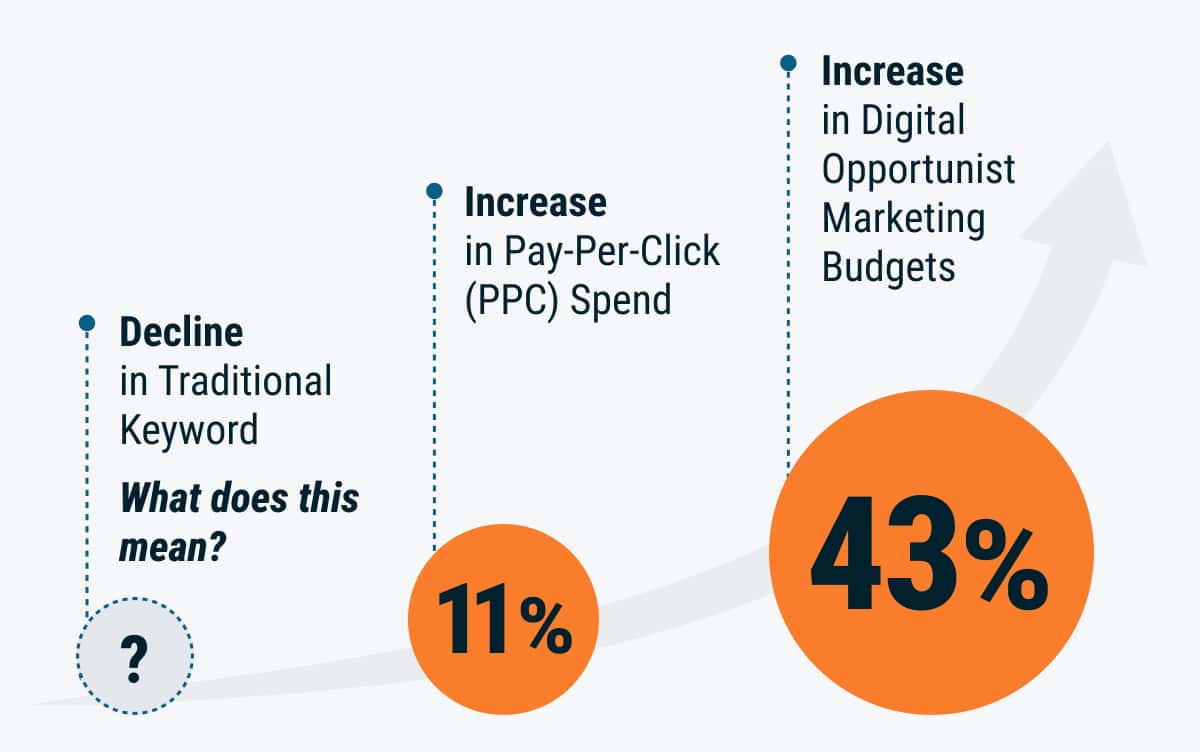
- Total opportunist digital marketing budgets increased by 43%
- Within that, average monthly Pay-Per-Click (PPC) spend grew 11%
- Their traditional keyword targeting declined
In other words, overall budgets are rising, with a growing share specifically directed to paid search.
At first glance, a decline in keyword targeting sounds like a good thing, right? But in reality, it shows a shift in how opportunists are trying to influence people. They’re moving away from buying simple keywords and toward purchasing full, question-based searches that mirror what people type into Google or Bing when they’re dealing with real problems.
Instead of short phrases like:
“car accident claim”
OR
“hurricane insurance claim help”
People are now asking full questions like:
- Does my insurance company cover water damage from a leaking pipe, or is that considered maintenance?
- Why did my insurance company deny my roof damage claim after a storm?
- What proof or documentation do I need for an auto claim with my insurance company?
Opportunists have adapted to this shift.
Short keywords are expensive and highly competitive. Longer, question-based searches offer more precision and clearer intent, making it easier to redirect people toward legal action once they land on a site.
Rather than competing for single keywords, opportunists are investing in paid ads, AI-generated content, and fake or doppelganger websites designed to capture these longer searches and redirect people away from insurers and legitimate providers and into legal marketing pipelines, referral networks, and funded litigation paths.
This is also why we’re seeing a decline in traditional keywords. Opportunists are no longer buying isolated words because people are no longer searching that way. They are buying the full questions people ask. Search has moved from keywords to phrases, and from rankings to intent.
Here’s a summary of what the data shows:
- A sampling of repeat bad actors, or ‘frequent fliers’ as we call them at 4WARN, are spending more money
- Paid ads are replacing traditional SEO as the primary way people find information online
- Digital targeting is happening earlier, before claims ever appear internally
- AI systems like Gemini are increasingly treated as trusted sources, while paid ads are expanding across tools like ChatGPT, meaning sponsored content will soon appear everywhere people go online for help
Why this matters:
These external signals, PPC increases, fake or doppelganger websites, and AI-driven content often appear weeks or months before claims activity. If you’re only looking at internal data, you’re seeing the problem AFTER it’s already started.
This is where 4WARN comes in. We monitor the digital ecosystem to surface these signals early for you, connect them to coordinated actors, and provide data and intelligence reports and guidance so you can take action before targeting turns into increased claims volume, lawsuits, and brand damage.
Learn more about How AI Is Used to Target Insurance Companies and Clients
*Data reflects activity between April 2024 and December 2025.
Knowing Is the First Step
Request a 4WARN Risk Score™ to understand your level of exposure and how we can help you take action.
About the Author
Beth Owens is an analytics leader with more than 15 years of experience using complex data to support new strategies that solve business challenges. As Vice President of Analytics at 4WARN®, she leads the company’s analytics and investigative intelligence work with a focus on digital activity, market trends, opportunistic actors, and connected networks.
Beth oversees the analytics behind 4WARN’s investigations, risk assessments, client reporting, and product development. She is responsible for the quality and accuracy of the company’s analyses and for translating highly complex findings into clear, meaningful intelligence for clients.
Before joining 4WARN, Beth held roles at Pivotal Analytics, Inspira Health System, Lourdes Health System, and Nestlé Purina. She holds a B.S. in Management from Rutgers University.

Get in Touch with Us Today
Empower your strategy with 4WARN's expertise and steer clear of tech-enabled claim instigation risks.