
 4WARN Insights Blog
How did an attorney identify and contact an accident victim almost immediately after the incident, without access to the insurer's claims data or systems? Did they hack in? Steal information? Buy a database of names?
These are actual questions that claims and Special Investigation Unit (SIU) teams have asked us at 4WARN. We’re writing about this because many of our clients have no idea how it works, and they’re pretty shocked when they find out.
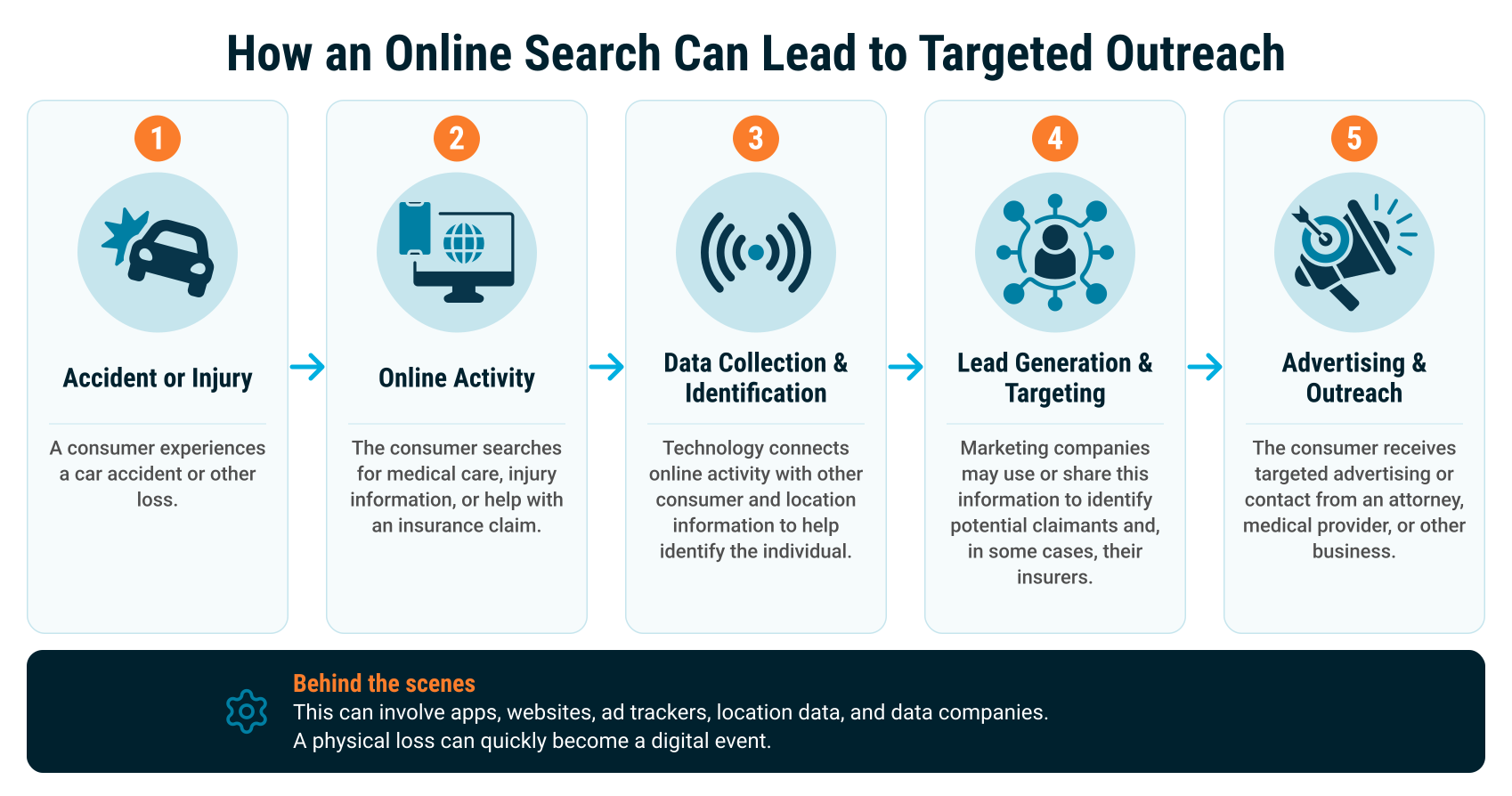
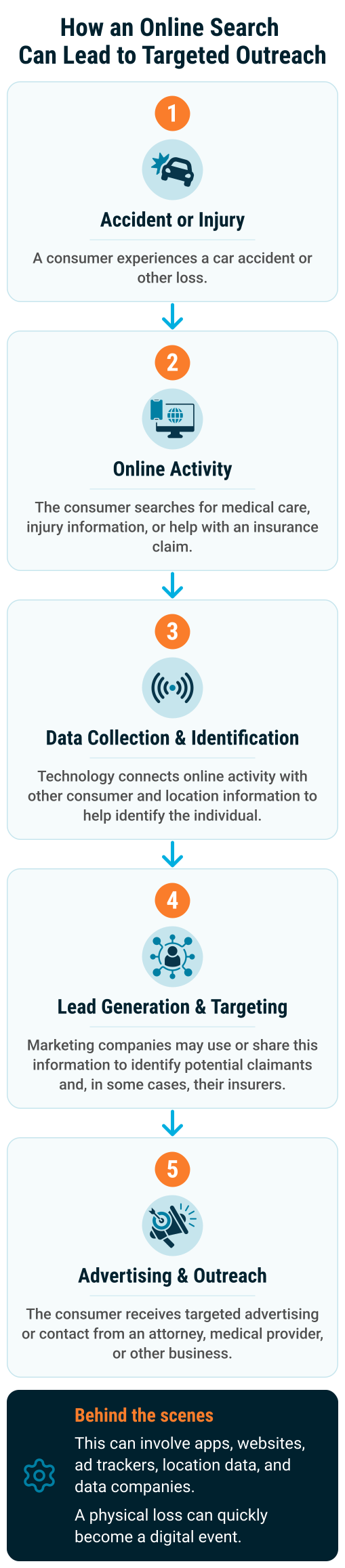
Think about what typically happens after a car accident. Someone goes online to find a doctor, research an injury, or figure out how to file an insurance claim. But what most people don't realize is that those searches, clicks, and website visits can tell companies quite a bit about what’s happening in their lives. And some companies are actively looking for that information to make money. It’s literally their business model.
They’re using technology to track online activity, connect it with other data, and identify people who may have recently experienced an accident or injury. This information is valuable to attorneys, medical providers, auto repair businesses, roofers, contractors, and others looking for new customers after a crisis or disaster.
The person searching online may never know that any of this is happening. They might simply notice an advertisement in their social feed or end up on a website that seems to offer exactly the help they need. Meanwhile, their insurance company may have no idea that these opportunists have already identified its policyholder as a potential claimant.
How Are They Doing This?
The thing that surprises most of our clients is that none of this necessarily requires access to an insurer’s claims system.
Opportunists can use commercially available technology to connect information from:
- Device IDs
- Email addresses
- Website visits
- Apps
- Location data
- Advertising activity…and more.
They can then add other consumer information and marketing data to help identify the specific person behind those online activities. That information may also help them figure out which insurer covers the individual.
Once a potential claimant has been identified, the information can move through marketing companies, lead generators, and referral networks before it finally reaches an attorney, medical provider, or another business that’s interested in targeting the individual.
Following the Digital Trail
So how do insurers figure out who the opportunists are?
At 4WARN, we monitor the digital connections between advertisers, lead generators, technology companies, referral networks, and other businesses. We look for patterns that help explain how someone was identified, when the targeting began, and who’s driving it.
We advise our clients’ Claims and SIU teams to look for a few things when something seems suspicious:
- Timing. How quickly did advertising or outreach begin after the accident? Was there online activity that might have triggered it?
- Who made contact? The attorney or business that ultimately reached the policyholder might be several steps removed from the company that first identified them.
- Connections between businesses. Different websites and companies may share advertising technology, tracking systems, call centers, or intake services.
- Who’s paying? Following the money behind advertising, consumer information, and purchased leads can help identify the organizations driving the activity.
A single ad, website, or referral doesn't necessarily mean the activity is illegal, but repeated connections across multiple sources can help identify a coordinated operation.
Want to Know Who's Targeting Your Policyholders?
If you want to know how attorneys or other companies are finding your policyholders, contact 4WARN to help you understand who’s behind the activity and how they’re doing it.
About the Author
Todd has over 25 years of experience founding and transforming multiple technology companies, leading organizational growth from start-up to post IPO, and helping build more than $5 billion in market value.
Earlier in his career, Todd co-founded and held leadership roles at Silknet (acquired for $4.2B by Kana), Unica (acquired for $480M by IBM), and Newforma (acquired by Battery Ventures).
Critical to the research that unearthed tech-enabled claim instigation, Todd has developed machine learning algorithms and analytical approaches that predict future events to help measure next-generation cyber risk targeting insurance organizations as well as impacts to financial solvency.
Todd is a graduate of Bates College with degrees in Physics, Astronomy, and Mathematics with advanced studies from the Smithsonian Center for Astrophysics at Harvard University.
Get in Touch with Us Today
Empower your strategy with 4WARN's expertise and steer clear of tech-enabled claim instigation risks.